SAME OLD YOU
ANIMATED FILM
by Davina J
A STATEMENT FROM THE ARTIST
DAVINA J

Music Credit: https://www.FesliyanStudios.com Background Music (fesliyanstudios on Youtube)
Tools: procreate and davinci resolve
This was my final project for Integrated Biology 38 -- a required course on a subject way out of my forte! So I decided for our final assignment to have some fun: I aimed to use a story-based animation to make complex concepts from evolutionary biology accessible and engaging for all students (ideally), but especially pre-teens :)
[Character design ideation! We took a lot of inspiration from other fish-humanoid designs)
The narrative is structured around three life stages (childhood, adolescence, and young adulthood) to parallel major transitions in vertebrate evolution. It was created with my own life stage in mind: college. I'm so different from the child I used to be -- different hair, different country, different values. Would I even recognise myself? And there's still so much life ahead of me -- I'm not even halfway done! And that's just how vertebrate evolution works: we've come so far we're barely recognisable, yet there's still little reminders of the underwater world we came from. And, of course, there's still so much change ahead of us!
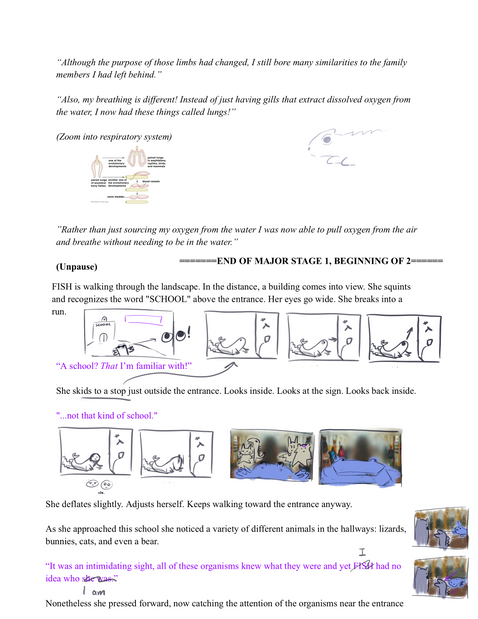
In the childhood stage, we depict the transition from coelacanth (an ancestral fish that still exists to this day!) to the Tiktaalik (4-legged lizard-like creature) during the Devonian Period. The character is introduced in an oceanic environment, curious and unfamiliar with land. Specific anatomical changes here included the transformation of lobed fins into weight-bearing limbs, the development of flexible wrist joints, and the enlargement of major bones such as the humerus, radius, and ulna. The reduction of bones between the skull and shoulders enabled the formation of a neck, while the development of lungs supported respiration on land. Background plant life, including Archaropteris (extinct trees), ferns, and lycopsids (one of the oldest groups of vascular plants), reinforces the environmental context.


[Beginning animations! As our animation timeline was very short (only 2 weeks), I had to simplify the work as much as possible. One shortcut involved finding as many places as possible where I can loop an animation -- creating dynamic movement without needing to draw more unique frames!
As a result, though, I think our film is closer to an animatic than an animation...]
In the adolescent stage, the character enters a chaotic pressure cooker where they evolve and change very quickly – a parallel to the Permian Extinction AND adolescent bullying/puberty. The creature is caught between forms. She's not the Tiktaalik anymore, but she's also not fully human yet.
The adaptations include elongation of the spine, shortening of the tail, and the formation of digits, including an opposable thumb. Limb positioning shifts as the femur aligns beneath the body and connects with the tibia and fibula for efficient terrestrial movement.
In young adulthood, the character is shown in a room of her own, with books and a graduation cap, symbolizing human intelligence and growth. Her developed prefrontal cortex reflects advanced cognition, while vestigial traits like piloerection subtly connect her to her evolutionary past. Even at this point of creature evolution, we're still not done! And, of course, elements of that fish are still within her, as they are within us!
[BELOW: initial storyboards]